If you’ve ever felt a burning fire in your stomach and were told to “just stop being so stressed,” you’ve been a victim of a medical myth that took decades to bust. For the longest time, the world thought ulcers were caused by a bad boss or too much chili.
Then came two Australians who changed everything by breaking every rule in the book
The “Accidental” Breakthrough: A Long Weekend and a Miracle
In the early 80s, Dr. Robin Warren and Dr. Barry Marshall were struggling. They could see these spiral-shaped bacteria in the stomach linings of sick patients, but they couldn’t grow them in a lab. In microbiology, if you can’t grow it, you can’t prove it exists.
They tried for months, following the standard 48-hour incubation rule. Nothing grew. Then, the Easter long weekend of 1982 happened.
Because of the holiday, the lab technicians accidentally left the culture plates in the incubator for five days instead of two. When they returned on Tuesday, they found the plates covered in colonies of H. pylori. It turned out these bacteria were just “slow eaters”—they needed more time to grow than anyone expected.
The Ultimate Sacrifice: Drinking the “Poison”
Even with the culture, the medical community laughed at them. “Bacteria can’t live in a vat of acid!” they said. Frustrated and determined, Barry Marshall did the unthinkable. He took a beaker filled with the H. pylori culture he had grown and drank it.
Within days, he was vomiting, had foul breath, and was in immense pain. A biopsy proved his stomach was teeming with the bacteria. He had successfully given himself a disease to prove he could cure it. That’s the kind of passion that wins a Nobel Prize.
What Is H. pylori? The Bacterium Itself
H. pylori is a Gram-negative, spiral-shaped bacterium.
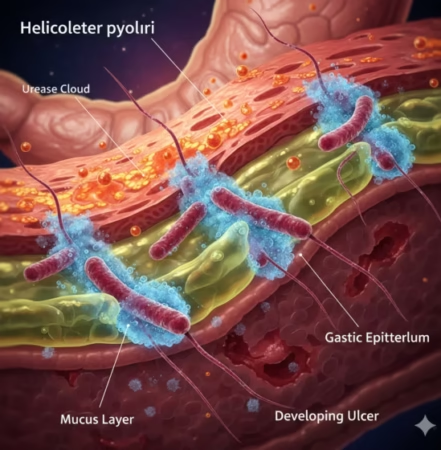
with multiple flagella (whip-like tails) that allow it to bore through the stomach’s protective mucus layer . Its survival depends on clever adaptations:

- Urease Production: The bacterium produces urease, an enzyme that converts urea into ammonia, neutralizing stomach acid around it .
- Motility: Its spiral shape and flagella allow it to penetrate the thick mucus layer .
- Adhesion: Special proteins help it stick to stomach lining cells .
- Biofilm Formation: It creates protective communities that resist immune attack .
Epidemiology: How Common Is It?
H. pylori is one of the most common human infections worldwide:
- Global prevalence: More than half the world’s population carries H. pylori at some point .
- Developing countries: Infection rates reach approximately 80% .
- Developed countries: Rates are lower, around 40% .
- United States: Prevalence ranges between 30-40% .
In China, infection rates are 45.4-63.6% in adults aged 20-40, rising to 78.9% in those over 70. Northern China shows higher rates than the south . In Malaysia, overall prevalence is modest at 13.5%, though variation exists among ethnic groups
Diagnosis: How Is It Detected?
Non-Invasive Tests
Invasive Tests (Endoscopy)
How Does It Penetrate the Stomach? (The Drill Bit Maneuver)
The stomach is a literal acid bath designed to melt meat. How does a tiny germ survive?
- The Shield:
It produces an enzyme called urease that creates a “cloud” of ammonia around it. This ammonia neutralizes the acid, creating a safe bubble for the bacteria. - The Drill:
H. pylori isn’t just a blob; it’s shaped like a corkscrew and has tails (flagella). It literally drills through the thick, sticky mucus layer that protects your stomach wall. - The Hook:
Once it reaches the actual stomach cells, it uses “adhesins” to lock itself onto the wall like a grappling hook. There, it begins to trigger inflammation and ulcers.
Why Is It So Hard to Get Rid Of?
If you’ve ever tried to treat a patient for H. pylori, you know it’s a nightmare. It’s one of the most stubborn infections in the world for three reasons:
- The Hiding Places:
It tucks itself deep into the folds of the stomach lining where antibiotics and the immune system have a hard time reaching it. - Antibiotic Resistance: Because we’ve used (and misused) antibiotics for decades, H. pylori has learned how to fight back. Many standard treatments now fail.
- Biofilms: It can form a protective “slime” layer that acts like a bunker, shielding the colony from medicine.
The Homeopathic Edge: Bergenia Ligulata
This is where your expertise comes in. While conventional medicine tries to “carpet bomb” the stomach with heavy antibiotics, remedies like Bergenia ligulata (Mother Tincture) work differently.
Instead of just killing the germ, Bergenia (Pashanbheda) helps heal the “soil.” It’s rich in tannins and Bergenin, which help tighten the gastric mucosa and reduce the inflammation that the “drill-bit” bacteria caused. It’s about making the stomach an environment where the bacteria can no longer thrive.
Tips for Readers:
- Don’t share spoons: It’s a family infection. If you have it, your spouse or kids might too.
- Watch the water: If you’re traveling, stick to bottled or boiled water.
- Test, don’t guess: If you have chronic acidity, ask for a “Urea Breath Test